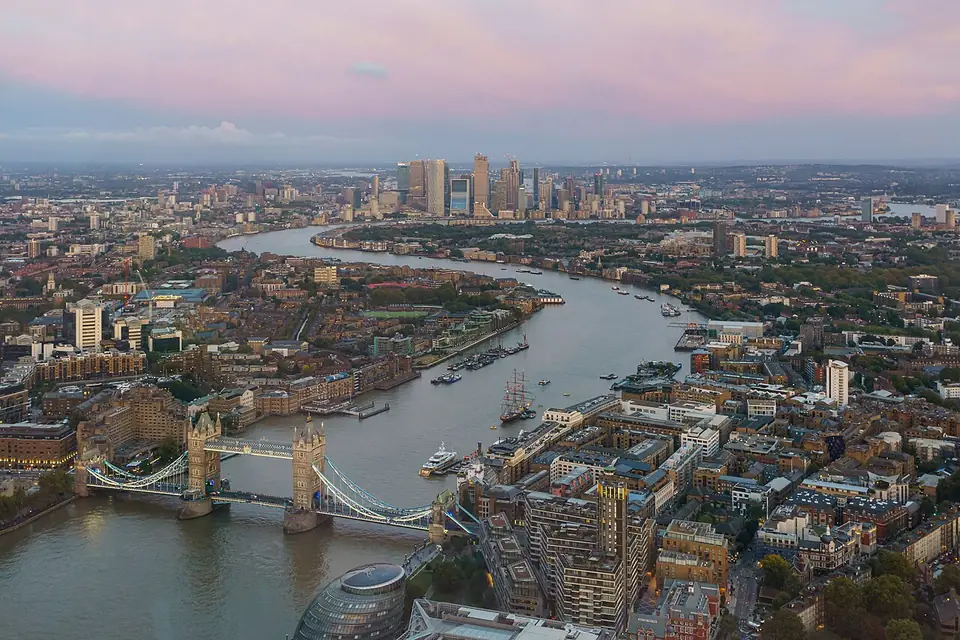
🇬🇧London
Two thousand years of city stacked on itself — Roman walls under glass towers, world-class museums that cost nothing, and a pub on every corner that's older than your country.
Mid-range figures, per person
Per person, no flights — those are just below. The mid-range figure is researched; budget and comfort scale it, so treat the two as rough. The trip calculator and hotels below break the day down properly.
Fares are into London — Heathrow for the long-haul carriers, Gatwick and Stansted for the budget fleet. Edinburgh has US directs for $50–150 more; Bath is an 80-minute train from London Paddington. The Europe row is short-hop fares into London. Ranges are typical fares booked 1–3 months out, checked mid-2026 — school-holiday peaks run higher, and patient shoppers beat the bottom end.
Prices checked · how we work these out
Is London expensive to visit?
Yes, by the standards of the cities this site covers: a mid-range day in London costs $180–280 per person, and its $230 midpoint is 156% above the $90 median across all 127 cities here. Within United Kingdom it runs 19% above the $193 average of our 3 United Kingdom guides. That makes it pricier than 126 of the 127 cities, with a cheap meal at $10–18 and a mid-range hotel at $190–320 a night.
How much does a trip to London cost?
| Trip length | Budget | Mid-range | Comfort |
|---|---|---|---|
| 3 days | $330–510 | $540–840 | $960–1,500 |
| 5 days | $550–850 | $900–1,400 | $1,600–2,500 |
| 7 days | $770–1,190 | $1,260–1,960 | $2,240–3,500 |
| 14 days | $1,540–2,380 | $2,520–3,920 | $4,480–7,000 |
Per person and before flights, 3 days in London costs $540–840 mid-range, five days $900–1,400, a week $1,260–1,960 and two weeks $2,520–3,920; a week costs about $770–1,190 on a budget and $2,240–3,500 travelling in comfort.
Per person in US dollars, flights not included. Each total is a daily range from the band above multiplied out: mid-range is the guide's researched figure and already includes a mid-range room; budget and comfort scale it by 0.6 and 1.8, so treat those two as rough. The trip calculator lets you set your own days and group size.
Entry & visa
For US, EU, Canadian, Australian and most Western passports, no visa for visits up to six months — but nearly everyone now needs a UK ETA, a £16 online travel authorization. Apply through the official 'UK ETA' app a few days before you fly; it lasts two years.
Visa rules turn on your nationality and change often — always confirm the current requirement for your own passport with an official government source before you book.
Quick facts
Money & what things cost
London is almost cashless: contactless card or phone works for everything from the Tube to a market stall, and plenty of places no longer accept cash at all. Skip airport currency desks entirely — if you want a little cash, use a bank ATM ('cash machine') in town, most of which are free.
What locals earn
| Earnings | Amount | Note |
|---|---|---|
| Average monthly salary (London, net) | ≈ £2,900 ($3,700) | well above the UK average — and mostly eaten by rent |
| National Living Wage | £12.20/hr (≈ $15.50) | reviewed each April; what much of hospitality earns |
Food & drink
| Item | Local price | ≈ USD |
|---|---|---|
| Supermarket meal deal (sandwich, snack, drink) | £3.60–5 | $4.60–6.30 |
| Fish & chips or a pub pie | £14–20 | $18–25 |
| Casual restaurant, per person | £20–35 | $25–44 |
| Mid-range dinner, per person | £35–60 | $44–76 |
| Pint of beer | £5.50–8 | $7–10 |
| Flat white | £3.50–4.50 | $4.40–5.70 |
Transport
| Item | Local price | ≈ USD |
|---|---|---|
| Tube ride, zones 1–2 (contactless) | £2.90 | $3.70 |
| Bus ride (unlimited changes within an hour) | £1.75 | $2.20 |
| Daily contactless cap, zones 1–2 | £8.90 | $11.30 |
| Black cab across the center | £15–30 | $19–38 |
| Heathrow → center, Elizabeth line | £13.90 | $17.60 |
| Gatwick/Stansted → center, train | £12–22 | $15–28 |

Where to sleep & what it costs
| Tier | Per night | Notes |
|---|---|---|
| Hostel dorm | £28–50 ($35–63) | Central beds go early — book weeks ahead |
| Budget hotel | £85–140 ($108–177) | Premier Inn and Travelodge are reliable; rooms are small |
| Mid-range hotel | £150–250 ($190–316) | The budget-killer — location beats stars here |
| Luxury | £400+ ($506+) | Claridge's, The Savoy — institutions in their own right |
Been recently? Check our prices
One tap per figure. Check-ins reset whenever this guide is re-priced, so they only ever vouch for the numbers you see here.
Trip cost calculator
$230 per person per day · 4 nights of lodging (Mid-range hotel)
A rough estimate, not a quote. The daily budget already includes a room, so one traveler pays exactly days × that budget; lodging is the room’s part of it, priced from the hotels below but never more than 45% of the trip. Extra travelers share the room and add only their own spending. Flights use the midpoint of the Getting there ranges above.
Getting around
- From the airport
- From Heathrow: the Elizabeth line, ~35 min to the center for £13.90 — the £25 Heathrow Express saves only a few minutes; the Piccadilly line is the £5.60 slow-and-cheap option. From Gatwick: Thameslink trains beat the pricier Gatwick Express for most destinations. Stansted and Luton are budget-airline land, an hour out by express bus or train.
- The Tube & buses
- Just tap a contactless card or phone — same fares as an Oyster card, and the daily cap (£8.90, zones 1–2) means you can't overpay. Buses are cheaper still, with unlimited changes inside an hour for £1.75. Stand on the right on escalators; this is enforced by glare.
- Taxis & apps
- Black cabs can be hailed on the street and every driver has passed 'the Knowledge' — pricey but never lost. Uber, Bolt and FreeNow all work. Avoid anyone offering an unlicensed 'minicab' outside a club at 2am.
- On foot
- Central London is smaller than the Tube map makes it look — Covent Garden to Leicester Square is a 4-minute walk that the map implies is a train journey. Santander Cycles (the red bikes) are £1.65 per half hour and the riverside paths are the best free sightseeing in the city.
Map
Drag to look around, or open Google Maps ↗ · Apple Maps ↗

Neighborhoods to stay in
- South Bank / Southwark
- Walk to the Thames, Borough Market, Tate Modern and the theatres — the best first-timer base.
- Covent Garden & Soho
- The center of everything, with prices to match. You'll walk home from the theatre.
- King's Cross
- Rebuilt from scratch and now genuinely nice; unbeatable train links, including to Edinburgh and Paris.
- Paddington / Bayswater
- Better value, next to Hyde Park, direct Elizabeth line from Heathrow.
- Shoreditch
- East-London nightlife, street food and galleries; a Tube ride from the postcard sights.

Things to do
Museums & galleries
Theater & shows
Markets & food
Nightlife
Tipping & etiquette
- The queue is sacred. Wherever two or more Londoners gather, a line forms — join the back of it, always.
- Stand on the right on Tube escalators. Blocking the left is the one thing that makes Londoners audibly angry.
- Let passengers off the train before boarding — people will physically wait for this.
- 'Sorry' means hello, excuse me, you stepped on my foot, and I stepped on yours.
- Pubs are order-at-the-bar, no table service, and rounds are bought in turns — if someone buys yours, you owe the next.
How to spend a trip to London
Central London is smaller than the Tube map makes it look, and the great free museums each swallow half a day — so every plan below groups by area, and most of the moving is done on foot rather than underground.
One day means one slice of the city, and the river is the slice to take. The Thames walk strings together more of what people come for than any route the Tube can offer.
- MorningThe British Museum at opening. It is free, and the first hour is the only quiet one.
- MiddayBorough Market for lunch, remembering it is closed on Mondays.
- AfternoonThe South Bank on foot: Tate Modern, Shakespeare's Globe, and the river path west towards Westminster.
- EveningA West End show on a same-week seat from the TKTS booth in Leicester Square, or a pint at Ye Olde Cheshire Cheese off Fleet Street.
Three days lets each day take one side of the city — the river, the royal set pieces, and the museums — without criss-crossing the map to do it.
- Day 1The South Bank end to end: Tate Modern, the Globe, Borough Market, then Tower Bridge and the Tower of London beside it.
- Day 2Westminster: the Palace of Westminster from the bridge, Westminster Abbey, then a walk up through the parks to Hyde Park and an evening in Covent Garden or Soho.
- Day 3Museums and markets: the British Museum or the Natural History Museum, then Camden Market and the canal walk down to Little Venice.
Five days is what this guide considers the right length for London, and the first that leaves room for both the theatre and a day out of the city.
- Days 1–3The three-day plan above: the river, Westminster, and the museums.
- Day 4East London: Shoreditch for street food and galleries by day, then back west for the late set at Ronnie Scott's or something serious at the National Theatre.
- Day 5A day trip. Windsor, Oxford, Cambridge and Bath are each about an hour to an hour and a half by train, and our Bath guide covers that one in full.
Safety & common scams
London is a safe big city with one modern exception worth taking seriously: phone snatching by riders on e-bikes, who pluck phones from hands at the curb in a second. Keep your phone away from the road edge and don't text while standing at a crossing. Beyond that it's standard big-city sense — pickpockets work the Tube and Oxford Street crowds.
Scams to know
- Phone snatchers on e-bikes — the signature London theft. Step back from the curb before you look at your phone.
- Three-card monte and cup games on Westminster Bridge — the winners you see are shills.
- Fake charity clipboards in the West End pressing for 'direct debits' — real charities don't need your bank details on the street.
- Unlicensed minicab touts outside clubs at closing — use an app or a black cab.
- Rickshaw/pedicab rip-offs in Soho quoting £100+ for a ten-minute ride — fares are now regulated, but just don't.
Emergency numbers: 999 or 112 (emergency) · 101 (non-emergency police) · pharmacies ('chemists', notably Boots) handle minor medical issues
Phone & internet
An eSIM (Airalo and friends, ~$15 for two weeks) or a giffgaff/Three PAYG SIM (£10–20) covers a trip; coverage is excellent and the Tube now has 4G/5G on most central lines. Note the UK left the EU — European plans no longer automatically include UK roaming, so check before relying on yours.
First-timer FAQs
Do I need an Oyster card?
No — just tap the same contactless bank card or phone on every gate and bus reader. You get identical fares and the daily price cap automatically. Use the same physical card each time so the system links your journeys.
How many days do I need?
Four to five for the greatest hits at a humane pace. London is also the UK's day-trip hub: Windsor, Oxford, Cambridge and Bath are each about 1–1.5 hours by train.
Is London really that expensive?
The hotel is the painful part. Nearly everything else can be done cheaply: the major museums are free, walking the river beats any tour, transport caps at £8.90 a day, and the £4 meal deal is a national institution. Splurge on theatre and one great dinner instead.
Should I buy a London Pass?
Usually not. Its headline attractions (Tower of London, Westminster Abbey) are worth paying for individually, but London's best museums are already free — do the math on what you'll actually visit before buying.
Similar cities to consider
 🇩🇪
Munich
GermanyGermany's richest big city and its most Bavarian — beer gardens under chestnut trees, a gold-and-baroque old town, the Alps on the horizon on a clear day, and the most expensive hotel rooms in the country.
 🇺🇸
New York City
United StatesThe city that never sleeps — Broadway marquees, a skyline you already know by heart, and a subway that gets you anywhere at 3am if you're patient.
 🇬🇷
Santorini
GreeceA drowned volcano with villages balanced on the crater rim. The most photographed island in Greece, the most expensive, and — if you plan around the crowds rather than into them — still worth it.
London or…?
Side-by-side cost comparisons with other guides.
Or weigh it against the other United Kingdom guides and its rivals abroad: